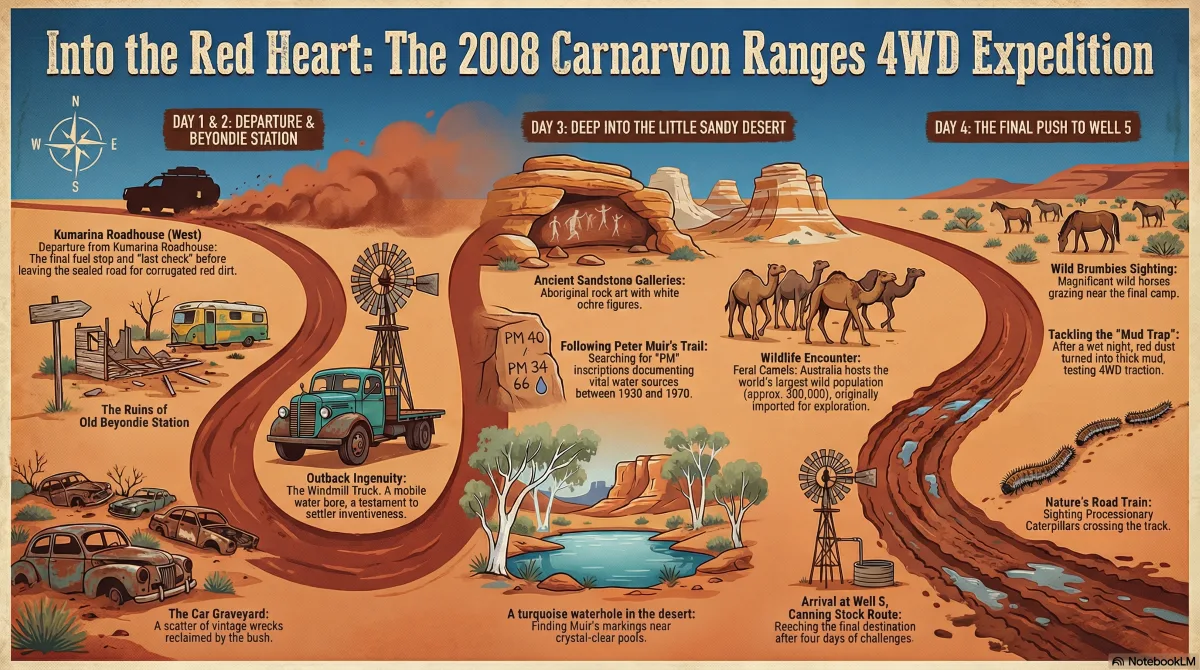
There's a specific moment when the blood starts pumping—it's when you finally point the bonnet down a red dirt track and leave the "black stuff" in the rearview mirror. In April 2008, my mate Steve T and I did exactly that. After a final fuel-up at Kumarina Roadhouse, a lonely outpost north of Meekatharra, we made our last vehicle checks. I'd left Lisa back at camp to enjoy the peace and quiet, while Steve T and I geared up for a proper, no-frills boys' trip into the Little Sandy Desert.
As we pushed into the vastness, Steve T led the way in his Prado, carving fresh tracks through the rust-red sand. I followed behind in the Ram, watching a massive plume of dust billow up from his tires like a marker flag in the outback air. We were properly committed now—two blokes, two 4WDs, and the shimmering horizon of the Carnarvon Ranges calling us forward.
A detour took us to the ruins of Beyondie Station, a photographer's paradise where the sweat and inventiveness of early pioneers are etched into every rusted scrap of iron. Standing among the skeletal remains of the homestead, the contrast hit hard; we roll in with air-conditioning and GPS, but these settlers thrived on nothing but determination. The showstopper was a turquoise Bedford truck fitted with a windmill tower—brilliant Aussie engineering that turned a standard truck into a mobile water bore. Survival in its purest form.
Our primary mission was following the waterhole trail of Peter Muir, a hard-as-nails dogger and prospector from the 1930s to the 70s who documented vital lifelines across these unforgiving deserts. We spent our days chasing his inscriptions—"PM34 66" and "PM 40 67" etched into the rock. Finding "Good Camp Rock Hole" painted on a red face forty years after it was written felt like uncovering a secret map.
These markers led us to desert oases—crystal-clear, amber-tinted pools tucked between towering sandstone cliffs. Ghost Gums with their distinctive white bark grew impossibly from the stone, their reflections perfect in the still water. But under massive sandstone overhangs, we discovered ancient Aboriginal rock art—white ochre figures and symbols preserved in these natural galleries, a humbling reminder of the people who knew these ranges long before any European explorer.
The desert was far from empty. We encountered a mob of about 20 feral camels watching us through the mulga, spotted a regal bush turkey, and even had a bloody great snake stretch across nearly the full width of our track—a quick reminder that we were visitors in its territory.
The first three days were a masterclass in outback driving, from conquering dusty corrugations to technical rock climbing. But after a thoroughly wet night, the desert transformed. The track became a slippery, rutted nightmare, turning the red earth into a mud trap that fought us every inch of the way.
The four-day dash culminated at Well 5 on the Canning Stock Route. Reaching it after battling dust, rock, and mud felt like conquering Everest. As the desert sky cleared, we sat in our camp chairs with cold drinks in hand, watching the light change over the red earth. This mix of mateship, grit, and history—this is what defines the outback spirit. It's why, no matter how much dust you swallow, the outback always gets under your skin.